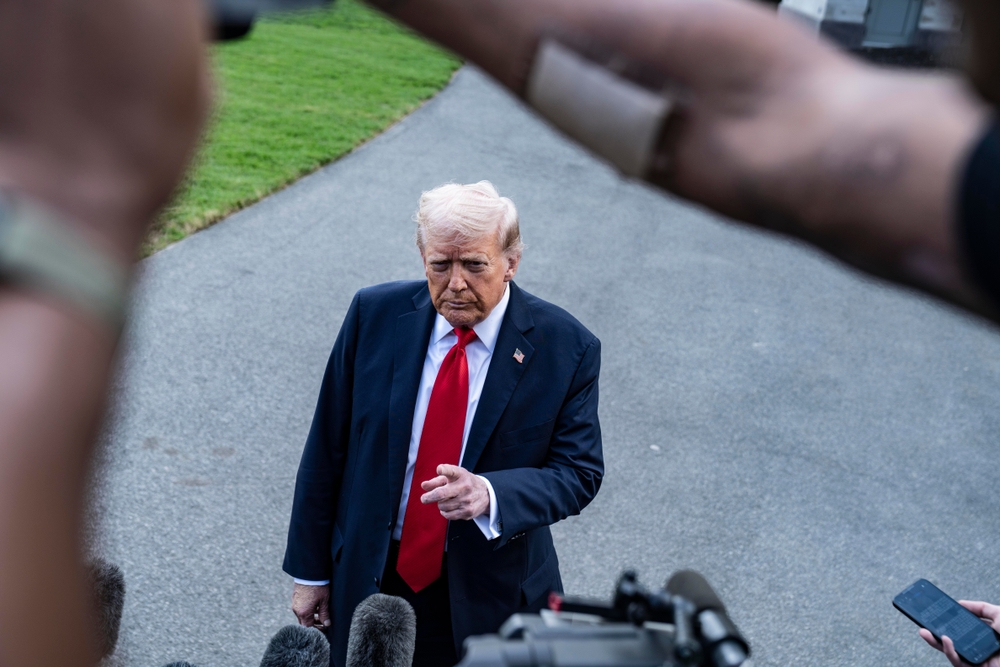
President Donald Trump’s sweeping tariffs faced intense scrutiny at the Supreme Court on Wednesday, in a case that could reshape the boundaries of presidential power and affect global trade. Several conservative justices challenged the administration’s defense of the import duties, which Trump said were necessary to revive U.S. manufacturing and address trade imbalances.
A coalition of small businesses and multiple states argued that the president overstepped his authority by imposing what they called an unlawful tax. The Supreme Court, with its 6–3 conservative majority, usually takes months to issue rulings, but many expect a faster decision in this high-stakes case.
Justice Amy Coney Barrett, one of Trump’s appointees, pressed the administration’s lawyers on the scope of the tariffs. “Is it your contention that every country posed a threat to our defense and industrial base? Spain? France?” she asked. “I can see it with some, but why so many?”
Billions of dollars in tariff payments are at risk. If the administration loses, the government may have to refund huge sums already collected—a process Barrett warned could become “a complete mess.”
Treasury Secretary Scott Bessent, Commerce Secretary Howard Lutnick, and U.S. Trade Representative Jamieson Greer attended the hearing. Officials said the White House was prepared with alternatives if the court ruled against it. “The White House is always preparing for Plan B,” press secretary Karoline Leavitt said before the hearing.
Later, Trump told Fox News that the hearing went well. He warned that losing would be “devastating” for the country and described the case as “one of the most important in our nation’s history.”
The Law Behind the Dispute
The case centers on the International Emergency Economic Powers Act (IEEPA), a 1977 law that allows presidents to regulate trade during national emergencies. Trump first invoked it in February to impose tariffs on China, Mexico, and Canada, claiming that drug trafficking from those nations posed an emergency.
In April, he expanded the tariffs, levying duties from 10% to 50% on goods from nearly every country. He said the U.S. trade deficit itself was an “extraordinary and unusual threat.” The measures took effect in stages while the U.S. pushed for new trade deals with foreign partners.
The administration argued that the power to regulate trade includes the power to impose tariffs. Solicitor General John Sauer warned that invalidating Trump’s actions could expose the U.S. to “ruthless trade retaliation” and “ruinous economic and national security consequences.” He described the crises as “country-killing and unsustainable.”
Justices Press on Limits of Presidential Power
The justices expressed concern over the scope of the president’s claimed authority. “This justification allows tariffs on any product, from any country, at any rate, for any period,” said Chief Justice John Roberts.
Under the Constitution, Congress—not the president—has the power to tax. The court has long limited how much of that authority lawmakers can delegate. Justice Neil Gorsuch asked, “What would prevent Congress from giving up all responsibility for regulating foreign commerce?” He said he was “struggling” to accept the administration’s reasoning.
Gorsuch also offered a sharp example: “Could the president impose a 50 percent tariff on gas-powered cars to address the extraordinary threat of climate change?”
Are Tariffs Taxes? A Key Legal Debate
Challengers argued that IEEPA never mentions tariffs and that Congress never intended to grant unlimited trade powers. Neil Katyal, representing small businesses, said the law allows embargoes or quotas but not revenue-raising tariffs.
The justices focused heavily on the statute’s wording and history. Presidents have often used IEEPA for sanctions, but Trump was the first to apply it to tariffs. Sauer insisted tariffs were “regulatory measures, not taxes,” and said any revenue raised was “incidental,” despite Trump’s public claims about billions collected.
Justice Sonia Sotomayor rejected that argument. “You say tariffs aren’t taxes, but that’s exactly what they are,” she said. Justice Brett Kavanaugh added that it made little sense to let the president block trade entirely but not impose even a small tariff.
Billions at Stake for Businesses
Analysts estimate that $90 billion in import taxes already paid could be affected—almost half of U.S. tariff revenue through September. Officials warned that if the decision is delayed until June, the amount could grow to $1 trillion.
The hearing lasted nearly three hours, far longer than scheduled, drawing a packed courtroom. If the Supreme Court sides with Trump, it would overturn three lower-court rulings that found the administration exceeded its authority.
Outside the court, small business owners watched closely. Among them was Sarah Wells, founder of Sarah Wells Bags, which designs and imports bags for breast pumps. Her company paid about $20,000 in unexpected tariffs this year and has since halted imports, shifted suppliers, and laid off workers.
After the hearing, Wells said she felt cautiously optimistic. “They seemed to recognize the overreach,” she said. “It felt like the justices understood that this power must be restrained.”